Stitching and Bitching
How Handmade Clothing Opposes the Capitalist Ideals of 21st Century America
By Phoebe Collins
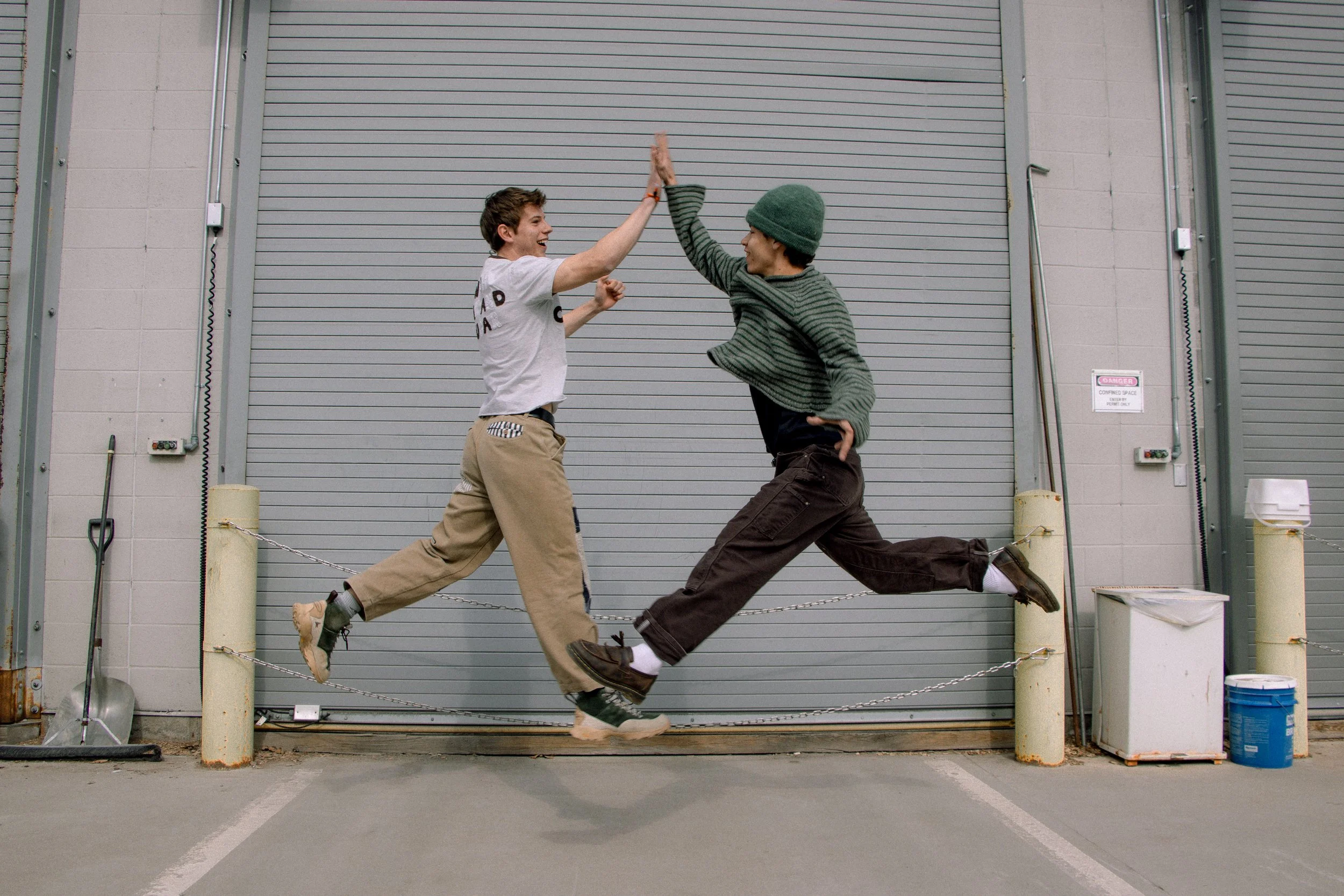
Photo by Loulou Politi
The American Dream preaches social mobility, equality, and freedom. It says just work hard enough, want it enough, and you, too, can succeed. Success, for Americans—whose social system is so deeply entwined with their economic system—is based on the accumulation of material goods. Success, to one born into capitalism, is never-ceasing accruement of financial wealth, private ownership, and growth of material possessions. The white picket fence that represents dreams of homeownership, the nuclear family, and the ability to afford nice clothes and nice food and a nice car. It also separates the individual from their neighbors and communicates that the exclusivity that comes with other successes is desirable. America teaches its children to seek personal professional advancement and accumulation of capital over all else.
The American textile industry was born in Lowell, Massachusetts in 1822.¹ Children worked fourteen hour days in the mills, girls got pulled into the industrial spinners by their hair, and the standard wage was three dollars per week. Millions of yards of fabric were produced annually under these conditions, marking the beginning of the Industrial Revolution in America and the first mass-production methods of fabric. Today, textile manufacturing has largely been moved overseas to China, Bangladesh, and Vietnam, south-Asian countries dominating the global market with low labor costs and similarly unethical working conditions.² With the suppliers who match the American demand for billions of pounds of clothing every year out of sight and out of mind, guilt can no longer dissuade consumers from overconsuming. Lower costs than ever allow for micro trends and massive clothing hauls and justification of cheap materials and short life cycles of individual pieces.
But casual fiber arts are seeing a resurgence in the US. Embroidery, needlepoint, crosstitch, knit, crochet, sewing, are no longer “grandma hobbies” but necessary skills for those wishing to be cool. Patterns like Petite Knit’s Sophie Scarf and Sydney’s Graham’s Lane Pants have gone viral. Visible mending is decidedly in. Middlebury’s Yarn and Yap club attendance is way up.
The exact motivation behind the fiber arts comeback is up for debate. Maybe the people are sick of significant percentages of polyester and acrylic and nylon even in “high quality” clothing with retail prices well over $100. Maybe the displaced guilt is making its way across the sea and into the outlet stores where five t-shirts for $60 isn’t even really that crazy. Maybe the quick dopamine hits that come from reviving your wardrobe for spring (inspired by several TikToks declaring you NEED more polka dots NOW!) aren’t having the same effect anymore. Maybe we’re all falling victim to the Nara Smith trad wife propaganda and sitting at home knitting instead of doing Instacart on the weekends to earn extra disposable income is actually a conservative plot to keep highly-educated women in the home and out of the job market! However you spin it, handmaking clothing is a form of active resistance to capitalist ideals that influence garment consumption in the United States.
While capitalist accumulation preaches quick and easy consumption of goods, handcrafts cannot be anything but slow. Fabric preparation includes washing, ironing, pinning, cutting, and overlocking before any sewing is possible. Yarn must be wound from hanks to skeins or balls before casting on to knit or crochet. One sweater can take anywhere from a couple weeks to several months depending on yarn weight, needle size, pattern complexity, and skill of the knitter. Sewing is a lot quicker, especially on a machine, but it’s still labor-intensive and time-consuming.
Dedicating time to handicraft can dissuade individuals from easy overconsumption of mass-produced clothing by forcing them to recognize that the prices of clothing sold on Amazon and Shein do not reflect the labor that must go into making them. Despite higher initial prices, the costs per wear often end up being lower for sweaters made with natural fibers and intention than for cheap mostly—plastic tops whose stitching falls out after a few abrasive washes. While the free market often sees money travel overseas when people buy from foreign vendors, sourcing materials at local yarn and fabric stores supports the basic economy of one’s own community.
Capitalism relies on the individual as the primary unit of production and consumption. People are free to act on their own judgement in the free market, are free to buy and sell how they please. The rational economist might believe, though, that all are acting in order to accrue as much capital as possible. Fiber arts, conversely, are based on community and reciprocity. You cannot learn to sew or knit or crochet without the help of others. Oftentimes, these skills are passed down among families, from grandmother to mother to daughter, or spread through public library stitch circles, community volunteer programs, or after-school clubs. The legacies of centuries of women who sat telling stories over their stitching are preserved. Since the dawn of the Internet Age, the amount of fiber arts resources to be found online has exploded, but even the online amenities of the crafting world—YouTube tutorials and free downloadable patterns from Etsy and Ravelry—were made by someone, somewhere.
The fiber arts community is one that teaches reciprocity, faith and patience instead of self-centeredness, competition and ruthless ambition. I was taught by my mother and now I pass on the same skills at Yarn and Yap every week. Even after weeks of working on one colorwork chart, I know that I will have a sweater to show for my work some time soon, just as long as I keep making stitch after stitch. It doesn’t feel tedious or stressful when I get to do it while talking and laughing with my friends who are working on their own projects and counting stitches and working 48 rows of stockinette and complaining about their fingers starting to cramp. Fiber arts teaches problem-solving (I do not have to throw away my entire project, using a seam ripper does not make me a failure), generosity (no fulfillment matches that that comes with seeing the joy on the face of a friend who has a new scarf), and humility (nothing I make will ever be perfect because it was made by a human and not a machine but at least it was made with love and care). It recreates the community, it is a result of generation after generation of creators.
Handmade clothes have also become symbols of resistance in their own right. Handmade armbands worn by students to protest the Vietnam War became the landmark Supreme Court case Tinker vs. Des Moines (1969). Millions of “Pussy Hats” were knit for the Womens’ Marches in 2016; the “Melt the Ice” hat, inspired by Norwegian anti-Nazi caps from the 1940s, is one of the most popular patterns on Ravelry right now. You won’t have to look far at a No Kings march or a climate change protest to see homemade linocut print t-shirts.
Even at its simplest—stitching and bitching with friends once a week— it is a revolutionary act against capitalism and the horrors it continues to breed in late modernity. Making clothes by hand is a productive alternative to the tantalizing doomscroll that further influences reckless consumption, a tool with which to protest, and a skill that begs and breeds togetherness in an era characterized by aggressive individualism. Crafting clothes brings us together and slows us down, one stitch at a time.
Endnotes:
1. National Parks of Massachusetts, “The Mill Girls of Lowell,” National Parks Service, December 3, 2025, https://www.nps.gov/lowe/learn/historyculture/the-mill-girls-of-lowell.htm.
2. UNU CPR, “Garments and Apparel,” United Nations University, May 1, 2024, https://unu.edu/cpr/article/garments-and-apparel.