The Art We Live In
By Anushka Quadir
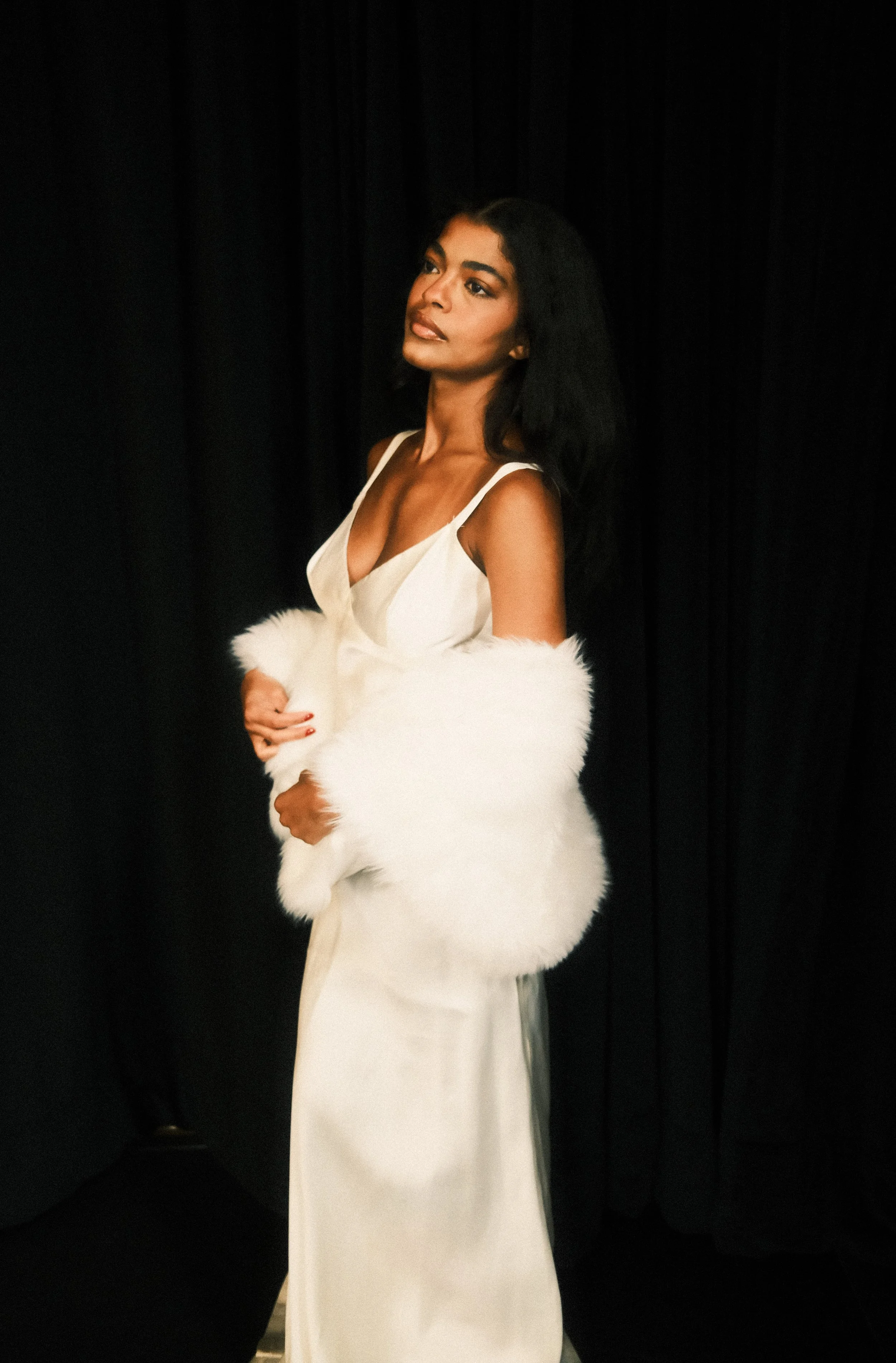
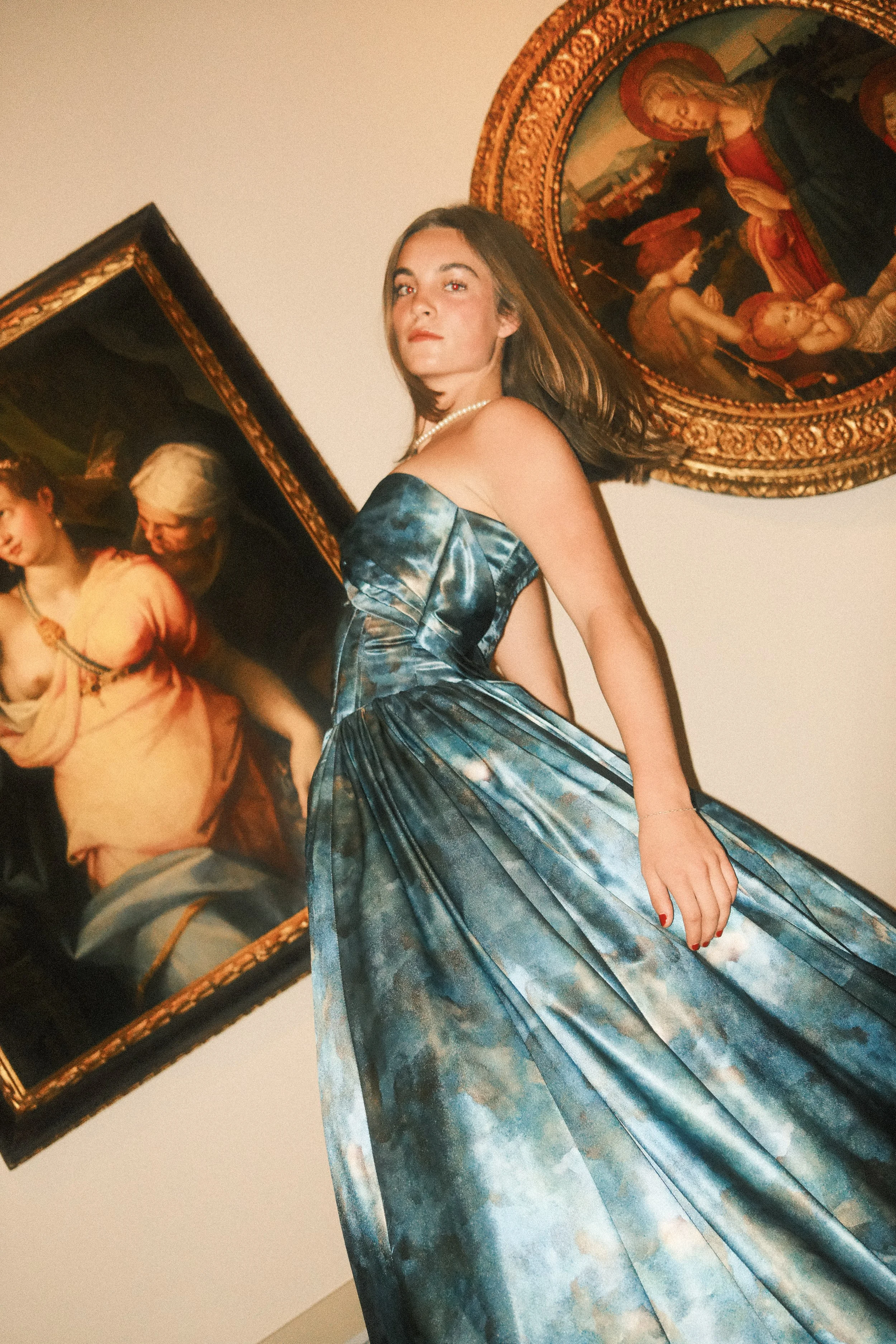
Photos by Madison Kim
Models: Ellen Sosa-Pena & Ava Pihlstrom
There is something fundamentally lazy about the way people dismiss fashion. It gets folded into this vague category of trends and overconsumption, as though that alone is enough to explain it, as though its ubiquity somehow makes it less serious. Of course, the fashion industry is far from unproblematic, its hierarchies and environmental impact are just some of its many flaws, but these failures do not negate its status as an art form. If anything, our constant visibility of fashion is exactly what makes it worth thinking about.
There is a persistent, restless quality to fashion that comes from seeing it on people moving through a city or across a dinner table, always in a state of flux. And the trends—they operate on a cycle of immediate obsession; the current fixation on Carolyn Bessette-Kennedy’s minimalist style will inevitably give way to something else by next month. It is ever present, and perhaps because of that, it begins to disappear into the background of our daily lives, to the point where we stop recognizing it as something constructed at all. That, I think, is where we go wrong. We rarely treat fashion as a creative practice. Instead we reduce it to its convenience, to the simple act of putting something on our bodies to get through the day. Even without any deliberate styling, our clothes still do the work of an introduction long before we actually speak.
FASHION IN REGARDS TO PERCEPTION
In The Fashion System, Roland Barthes shifts the focus from the material of the clothes to what he calls a system of signs. Without leaning too heavily into theory, what he describes is fairly simple: the garment itself matters less than how it is worn and how it is read.¹ Nothing is ever neutral in fashion, because whether we intend it to or not, meaning gathers around what we wear—even the act of “opting out” is a message. It becomes difficult, then, to imagine ever really stepping outside of that system; no matter how much effort goes into an outfit, it still enters a world where it is inevitably being read and judged.
At the same time, the everyday act of getting dressed complicates how we think about creativity. We tend to reserve that word for artists, designers, or people working within these recognised artistic fields. But I find styling yourself is a simpler form of creativity that happens daily. When you’re choosing what to wear, pulling from a Pinterest mood board, and making those aesthetic decisions—that is, by definition, a practice of art.
What is interesting is how differently we treat fashion compared to other forms of visual art. A painting in a museum practically begs for analysis. People are comfortable asking what a painting means, largely because art on a wall, at least in Western contexts, is already framed as something to be looked at for simply being displayed. The idea of art for art’s sake, a nineteenth-century French slogan, reinforces this, by placing value in beauty over function. Fashion unsettles that expectation. Because it is used, it is often seen as something beneath art, reduced to just function. As a result, it is more often taken at face value than actually interpreted, and it is rarely given the opportunity to be understood with the same appreciation as the “fine arts.”
FASHION VS MUSEUMS
We have also been taught to think about where art has the right to exist. By the eighteenth century, institutions like the French Royal Academy had begun to formalise artistic value, placing art within very controlled spaces, categorising it, and in doing so, separating it from everyday life. Art acquired distance, and that distance still dictates how we see art today. When something is placed within a gallery, it is already framed as worthy of attention, you take a pause, and you interpret what the piece conveys. Fashion never offers that pause because it appears on moving people. If anything, the fact that it is encountered so fast and so unconsciously makes it more difficult to parse. You have to interpret it the moment you see it. You don't have that distance you usually rely on when you're looking at a painting.
Because fashion never secured that “museum distance,” it remains stubbornly tied to the body and to the market, circulating too quickly to ever feel contained. That accessibility is exactly why it is so often dismissed as shallow, and frequently, the industry proves the critics right. Fast fashion has democratised style to such an extent that individuality sometimes seems to disappear amidst our uniformity. When a brand like Fashion Nova can replicate a designer’s work almost instantly, it’s hard to argue that fashion is about anything more than a copy, and the speed only reinforces the idea that it is a derivative industry.
FASHION & CONSUMERISM
It's ironic how we only grant our attention to things that are hard to find. By tethering value to scarcity, we’ve essentially agreed to look right through anything that is abundant. Walter Benjamin, writing on mechanical reproduction, famously called this quality the “aura.”² He defined it as a “unique phenomenon of a distance, however close it may be,”³ comparing it to a mountain range on the horizon or a branch casting its shadow.
But once that mountain is within reach, we lose interest. Benjamin’s point was that mass production kills our sense of reverence. When an object can be endlessly replicated, it stops being special and just becomes another thing we've seen a thousand times. This explains why fashion is so consistently taken for granted. We’ve been conditioned to save our appreciation for the one-of-a-kind archival piece, while we're almost embarrassed to find merit in a garment that exists in millions.
This is why the clothes we see every day are so undervalued. While we must critique the fast-fashion model, we shouldn't assume that reproducibility inherently erodes significance. A silhouette takes on a completely different life depending on the person wearing it. Fashion is rarely granted “art status” unless it is stripped of its practical necessity. We tend to save that title for the elite—the high-concept couture houses defined by craftsmanship—or, conversely, we validate it through sheer market dominance and massive valuations. Everything in the middle is dismissed as mundane. As fashion is a true art form, its value should extend beyond its exclusive edges and consumerism, and into the way people actually live.
Endnotes:
1. Roland Barthes, The Fashion System, trans. Matthew Ward and Richard Howard (Berkeley: University of California Press, 1990).
2. Walter Benjamin, “The Work of Art in the Age of Mechanical Reproduction,” Penguin Great Ideas (London: Penguin Books, 2008).
3. Benjamin, “The Work of Art in the Age of Mechanical Reproduction.”