Unfit for the Mannequin
By Malayhe Council
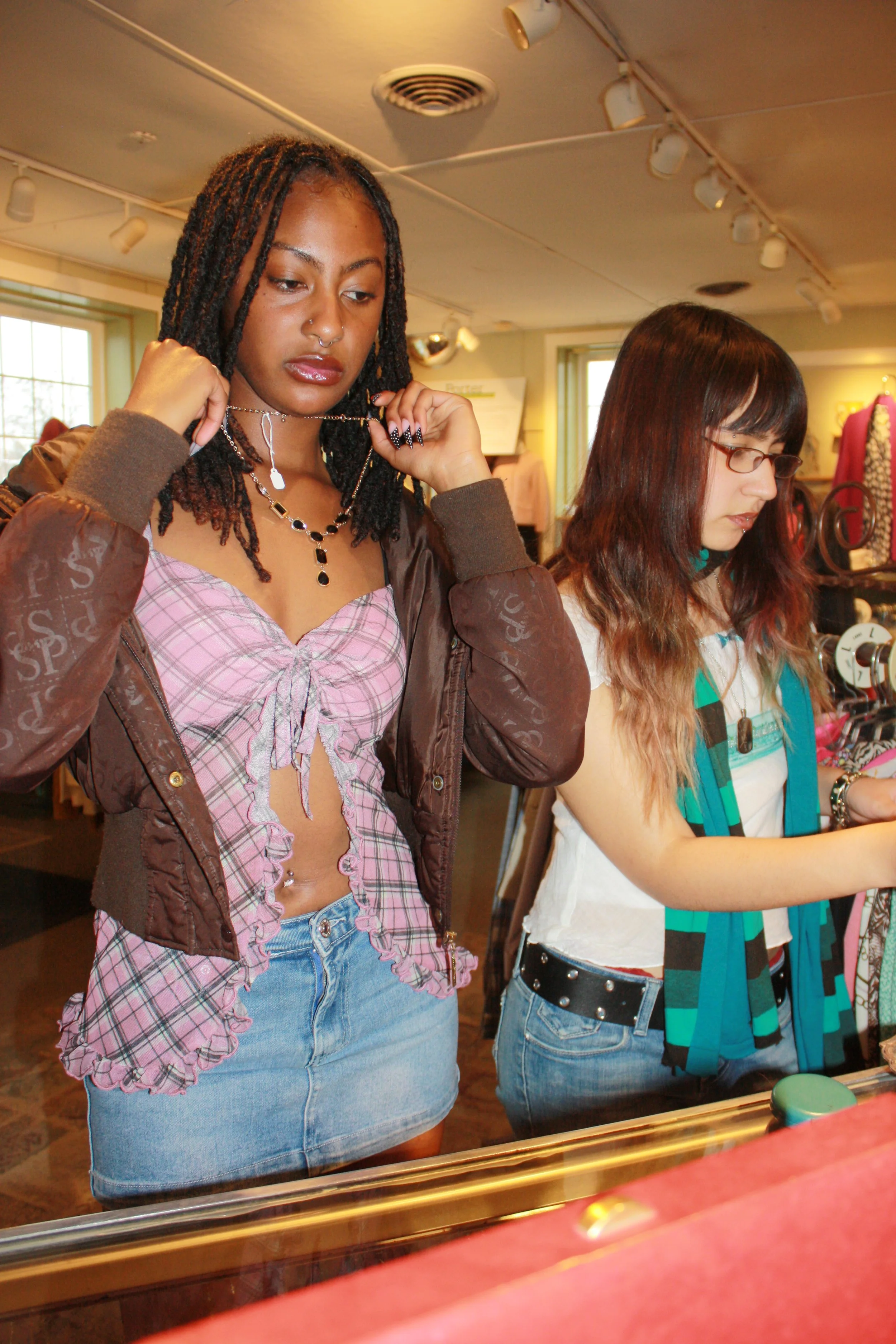
Photo by Caroline Deleon and Liliana Lopez-Velazquez
The music is low and warm, humming through the room like it belongs there. Sade is singing softly through a vinyl record player, the needle crackling each time it turns. A woman stands in front of her full-body mirror, adjusting the belt on a pair of high waisted blue jeans. The pants are slightly tapered at the ankle, and tucked into them is a fitted black top with a low neckline. She has a fresh, voluminous blowout, with thick curls brushed out just enough to give that soft, bouncy, fullness. Gold hoops hug her earlobes and leave soft kisses against her neck as they dangle. Over it all, she throws on a denim jacket, oversized but intentional, sleeves pushed up to the elbows. For a moment, the room feels like it belongs to another decade—scenes like this are what vintage fashion promises. Not just clothing, but atmosphere. A feeling. A quiet return to something that already lived a life before we found it. But what exactly counts as vintage? The term refers to clothing and accessories that are at least 20 years old but typically no older than 100.¹ What if a majority of us are subconsciously returning to an older philosophy of dressing? One that echoes the “French wardrobe,” a smaller, more intentional collection built on a limited number of high-quality pieces. In a world of infinite, identical options, we are choosing the finite. We are not just looking for clothes, but for something that feels grounding in a world that is increasingly slipping out of our hands.
Dressing Against Sameness
I remember the day when my sociology professor told the entire class that we all looked the same: “Jane has on a hoodie,” she said. “So does Michael. And so does half the class. I’m confused about the individuality you all claim to value and possess.” Moments like this reveal a larger pattern–a subtle submission into digitally curated taste.With that being said, the comment landed heavier than she probably expected. And after she voiced that observation, I started thinking about how uncomfortable it feels to be labeled as identical to someone else. Who actually wants to be described as a copy? Who wants their appearance, something held in such high esteem, reduced to a duplicate of another person standing beside them? Being a replica of someone actively diminishes the very things that nurture our souls—our personal niches, our quirks, the small choices that allow us to express who we are. They begin to disappear when everyone is drawn towards the same aesthetic cycles. However, vintage fashion challenges that system. Walking into a thrift store, a classic boutique, or even your mom’s closet introduces unpredictability. A leather jacket from 1987 might sit beside a silk slip dress from the late 1990s. A worn leather belt may carry the marks and energy of decades of usage. These pieces store history, and more importantly, they are far less likely to appear on ten other people walking across campus. In that sense, pre-owned attire becomes a quiet rebellion against sameness. It allows people to construct a look that feels personal rather than algorithmically suggested, and what better way to resist this unspoken uniform than a trip to Goodwill?
Borrowing The Uniform of Certainty
Beyond the search for individuality, there is another reason throwback fashion resonates so deeply today. For many young adults, legal maturity feels financially unstable in ways previous generations did not experience. For example, 46% of Gen-Z adults rely on financial assistance from family, and over half report that they do not earn enough to live the life they want.² Additionally, housing costs present an even steeper barrier. 67% of Gen-Z adults struggle to afford housing costs, making us the generation that is hit the hardest by rising living expenses.³ These statistics demonstrate that when financial independence feels like it is at an increasing distance, the future may feel uncertain. So, we reach for vintage outlines not just because they look good, but because we are borrowing the textures of a world that feels attainable–a world where adulthood seemed clearer, and the milestones of life felt like they were actually within our grasp. For instance, I know I cannot be the only one who saved up $300 to buy a Lululemon set, but by the time I got it, the media had already moved on to Alo. Likewise, today's economic pressures reshape how we currently engage with fashion, shifting it from consumption to adaptation. Instead of constantly chasing the shifting trends or expensive luxury brands, vintage attire allows one to step into another era altogether. Nonetheless, whether you are rocking an 80s windbreaker or a pair of bell bottoms from the 60s, these clothes do more than provide affordability; it connects the wearer to a period that, at least from the outside looking in, feels more stable, more structured.
The Allure of the Past
Then there are the nights where longing for a world we never knew becomes difficult to ignore. Close your eyes for a moment please. Imagine the crackle and hiss of a needle settling into the groove of a vinyl record. A bass line rolls in slowly as Luther Vandross begins to sing "A House Is Not a Home." You are standing in the middle of your bedroom, the entire space bathed in the amber glow of a single lamp. You smooth down a silk dress and grab your coat off the chair. Outside, leaning against a classic American muscle car, is a man who looks like he belongs to another era entirely, unbothered by the noise of the world. He smiles as you step outside, your kitten heels tapping a steady rhythm against the pavement. The engine hums low as he drives you both through the city toward a jazz club. Inside, a saxophone drifts through the room like warm air while couples sway slowly to the rhythm. Now, open your eyes. Since this is not a life most of us have known, the scene does not come from memory, but from something we have learned how to imagine. It is pieced together by music, film, and inherited images. What makes landscapes like the one I painted so powerful is not that they are “real,” but that they offer something the modern world often lacks: a sense of slowness and emotional clarity. Fortunately, that is exactly what vintage fashion taps into. When we wear vintage, we are not simply wearing clothing from the past. We are briefly stepping into the atmosphere of an idyllic moment in time, and then, just for a moment, the world feels fuller.
All in all, vintage fashion’s resurgence is not simply about aesthetics, but a deliberate response to three modern conditions: the pressure of sameness, the instability of economic adult hood, and a growing desire to escape the blandness of digital life. When someone pulls a trench coat from a thrift rack, they are not merely choosing a garment, they are choosing substance. Throwback clothing is not about pretending the past was better; it is about reclaiming character in a world that continually flattens us out. It is fabric with memory and style with intention. In reaching backwards, we quietly grasp our unique ways of stitching ourselves back into the present–we become our own again.
Endnotes:
1. Christian Allaire, "What Is Considered Vintage?,” Vogue, October 13, 2022, https://www.vogue.com/article/what-is-considered-vintage
2. Bank of America Institute, “Nearly Half of Adult Gen Zers Getting Financial Help from Parents,” July 10, 2024
3. Katie Jensen, “ Gen Z Hit Hardest by Housing Cost Squeeze,” National Mortgage Professional , June 24, 2024,https://nationalmortgageprofessional.com/news/gen-z-hit-hardest-housing-costs-squeeze-us-households