Freeskiing’s New Wave
By George Madison
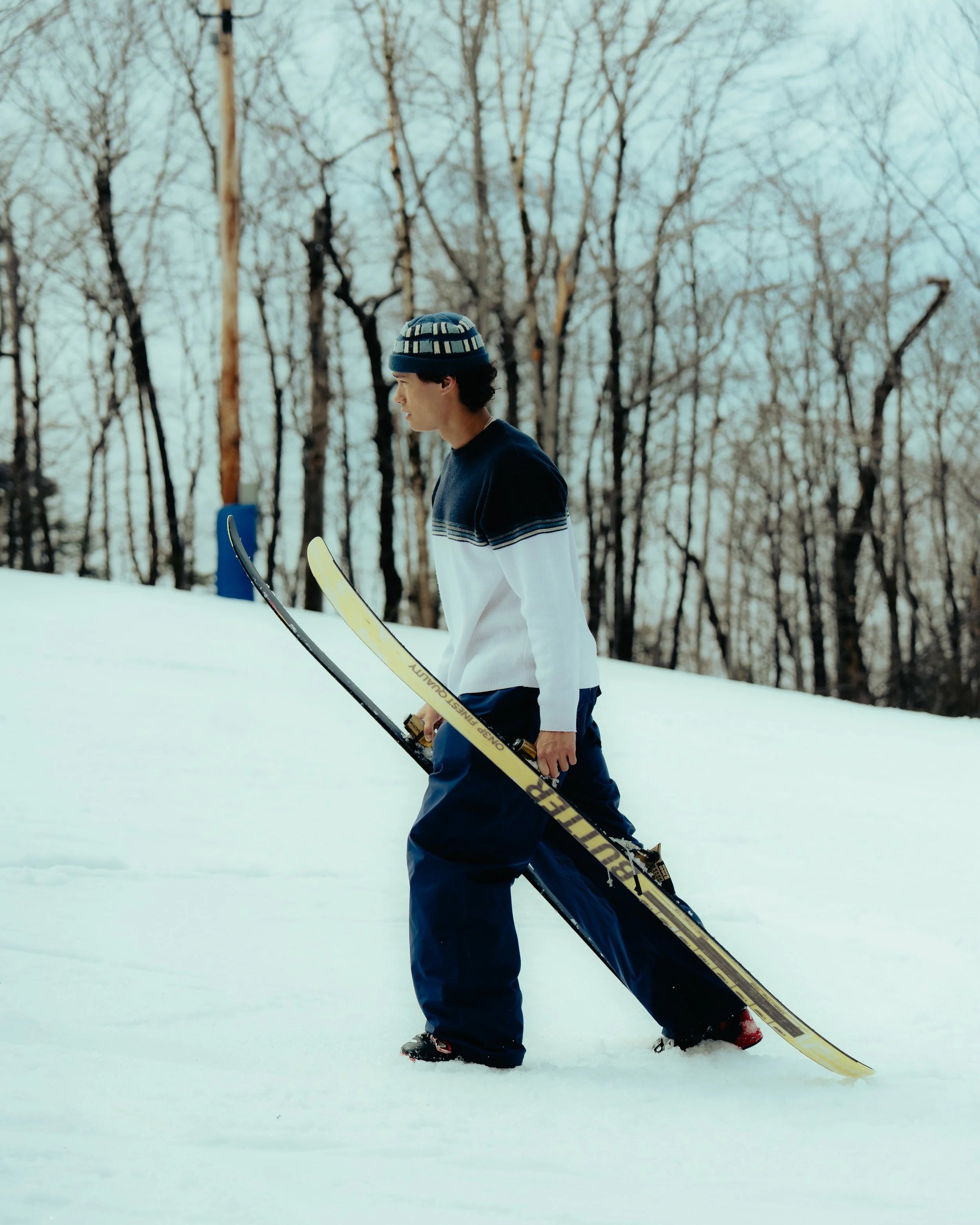
Photo by George Madison
Model: Robert Altavilla
In few sports is fashion such an integral part of the ethos as in freestyle skiing. Freeskiing is all about style. Self-expression in skiing incorporates not only body movements, but also clothing.
The early 2000s saw the rise of freestyle skiing as a mainstream sport. No longer were terrain parks reserved for snowboarders. Legends of the sport such as Tom Wallisch and Simon Dumont rose during this time period. Wallisch entered the scene after winning Level 1’s SuperUnknown video contest, which discovers talented non-professional skiers, in 2007 and would go on to win multiple x-games medals. Dumont rose through the ranks as a half-pipe skier and, like Wallisch, starred in numerous ski films. Their skiing style of clean landings and afterbang, a style of landing where the skier allows their head and shoulders to dip with impact, was accompanied by tall tees, open jackets, baggy pants, and colorfully patterned kits or outerwear. Hip hop music and style had a strong influence over freeskiing’s culture and fashion. An iconic photograph shows Wallisch squatting in a parking lot to stretch out his tall tee before hitting the park at Keystone, Colorado. Simon Dumont’s red and white block patterned Oakley kit still symbolizes freeskiing’s gangster era. Level 1 Productions’ 2009 film Refresh highlights the peak of this era, from Wallisch’s opening segment to Phil Casabon and JF Houle’s urban segment, we see colorful tall tees that stretch past skiers’ knees, old-school headphones, super baggy pants, and sports jerseys.
By the mid 2010s, freeskiing was progressing fast. In 2011, now 3-time X-games gold medalist Bobby Brown became the first skier to land a triple cork¹, a trick where a skier flips three times while spinning. In 2016, Cody Laplante landed a triple cork at age 13.² Tired of big spins and repetitive rail tricks, the community craved something different. The Bunch provided that. Led by Scandinavians Magnus Graner and Par Haglund and American Alex Hackel, the Bunch brought a whole new approach to skiing. They found creative ways to hit urban features, hitting not only large handrails and wallrides, but also park benches and innovative transfers. On the hill, they developed a signature style of swerve skiing, characterized by large arm movements, quick turns, and butters or presses with the noses or tails of their skis. Afterbang was replaced by landings with arms wrapped to the side and upper body twisted. They coined the term “loose but lit,” making imperfections, near falls, a part of their style. Their outfits too diverged from the status quo. They ditched poles for mittens, track pants, and scarves. The new wave was born.
The Bunch’s 2016 film Finito, the last of a trilogy, embodies the rising tide of new wave skiing. Their innovative style of skiing is on full display. In the eleventh minute of the film, Magnus Graner skis down a narrow snow bank between cars and trees, performing several small jumps and presses.³ A clip with no handrail, big jump, or spins, would never have made the cut of an early 2000s ski film. The Bunch reaffirms that freestyle skiing should be fun, that you don’t need to do the biggest most technical trick to gain respect. Quickly, skiers around the world could be seen rocking track pants and wearing their goggles backwards on their helmets. Vermont’s Sugarbush parks became the East Coast home of new wave skiing. A whole subset of freeskiers, from middle schoolers to professional skiers emulated The Bunch’s style, emphasizing creativity, such as butters, one-foot backslides or frontslides, and unique grabs over technicality in their skiing.
As time went on, the new wave saw evolution. Skiers began incorporating new wave style into bigger tricks and features, emphasizing speed and switch skiing. The fashion evolved with it, as button downs, sweaters, and beanies became popular alongside the mittens and hoodies of the original movement.
In 2020, Dumont came back from a 5-year hiatus and teamed up with Tom Wallisch to drop a video titled “Resurrection.” Wallisch rocked a tall tee and Dumont dusted off the iconic Oakley pants. The description read, “Simon and Tom are back together for a park edit determined to bring back the style of 2009. Old wave tricks, afterbang, and ignancy.”⁴ Many in the community praised the return of swagger, calling it the death of new wave swerve skiing. But in the end, the video part represented only a final flicker of nostalgia for an era gone by.
In the 2020s through the present day, elements of new wave skiing and fashion have blended into the mainstream freestyle skiing culture. In the 2026 Olympic big air final, Tormod Frostod, a Norwegian slopestyle and big air skier, won with a nosebutter double bio 1620, doing only 2 flips and pressing into the takeoff, with Mac Forehand taking second with a nosebutter triple cork.⁵ The podium represented a departure from the spin to win attitude to rewarding creativity and details such as grabs and presses.
In the 2020s post new-wave era, ski fashion has become more individualized. Rather than adhering to one dominant fashion trend, skiers have blended elements of new wave style with new silhouettes and accessories. Baggy cargo snow pants are back in a big way along with parachute pants. The long-dominant ski companies such as K2 Skis, Faction Skis, and Volkl Skis now have competition from numerous independent brands such as The Bunch’s brand 1000 skis, Jet Skis, and Vishnu Freeski. These brands have embraced freeskiing’s core. You may not see their skis on an X-games or Olympic podium, but Pro skier Henrik Harlaut’s brand Harlaut Apparel along with independent brands such as Arsenic Anywhere, Lizard Stuff, and Anytides are constantly sold out of their baggy pants. Skiers such as Sam Lobinski, a park skier from the Midwest, popularized hats with braided tassels, also worn by Tormod in the 2026 Olympics.
Film parts feature skiers with no poles alongside skiers with long, backcountry-style adjustable poles. Zootspace, released in 2021 marks the evolution into the post new-wave era of freeskiing, showcasing a style of skiing that brings new-wave style to heavy urban features. Skiers wear a wide variety of shells, hoodies, fleeces, and tee shirts. The New Wave has allowed for this surge in individual style, having redefined the boundaries of ski fashion by shunning the status quo for a different style of skiing and outfits.
Who knows what the future holds for freeskiing fashion? Only one thing is certain. The next generation will find their own way to express themselves on snow, stretching the boundaries established by those who came before them.
Endnotes:
1. “Bobby Brown Triple Cork.” Newschoolers, n.d., Bobby Brown's Triple CorkNewschoolers.comhttps://www.newschoolers.com › news › read › Bobby-...
2. Davis, Connor W. “This 14-Year-Old Is a Way Better Park Skier Than You.” FREESKIER, 12 Aug. 2016, https://www.freeskier.com/14-year-old-way-better-skiing
3. “The Bunch – Finito.” Vimeo, uploaded by The Bunch, n.d., https://vimeopro.com/thebunch/trilogy/video/149763832
4. “Resurrection.” Youtube, uploaded by Good Compenny, https://youtu.be/iZ2OqcymFYs?si=ThKT0Wj1MLI4s3wz
5. “Frostad and Forehand Have Battle for the Ages” Youtube, uploaded by NBC Sports, https://youtu.be/u0mfCxGDvg4?si=3463KAq57v6AFvKU